Ask a broker where luxury retail is strongest in New York and you get rent tables. Ask a brand and you get a press release. Ask a candidate deciding where to build a career, and nobody has an answer at all.
That gap matters. Two client advisors with the same title, the same brand, and stores four miles apart are doing two fundamentally different jobs — and building two fundamentally different books.
Here is the map, corridor by corridor, and what each one asks of the people inside it.
First, the honest part: nobody publishes sales by district
No luxury house discloses store-level revenue. No brokerage, agency or business improvement district tracks sales by neighbourhood. Anyone who hands you a figure for "SoHo's annual luxury sales" invented it.
What the market does publish are four proxies. Used carefully, they are enough.
Rent is revealed preference. Luxury operators underwrite rent at roughly 10 to 20 per cent of forecast store sales. When a house signs at $726 per square foot on Broadway, it has already modelled the volume to carry it. Rent is the brand's own sales forecast, made public.
Ownership is conviction. Kering paid $963 million for 715–717 Fifth Avenue. LVMH, Prada and Rolex have all moved from tenants to owners on the same few blocks. You do not buy the building unless the P&L inside it already works.
Store count is deployment. Madison Avenue absorbed more than 70 luxury apparel and accessories tenants in two years. Capital votes with doors.
Category mix is the tell. Where jewellery and watches cluster, closing rates are highest. That category carries the deepest margin and the least tolerance for browsing.
The whole city, first
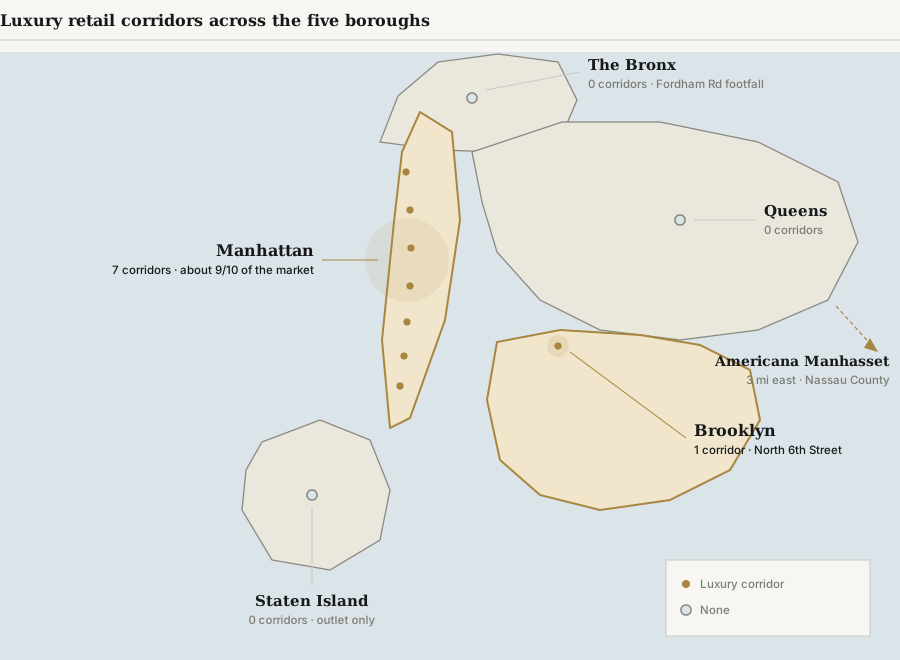
Before the corridors, the shape of the problem. New York has five boroughs and eight luxury corridors. Seven of them are on one island. The eighth is one street in Brooklyn.
Now the island, in detail
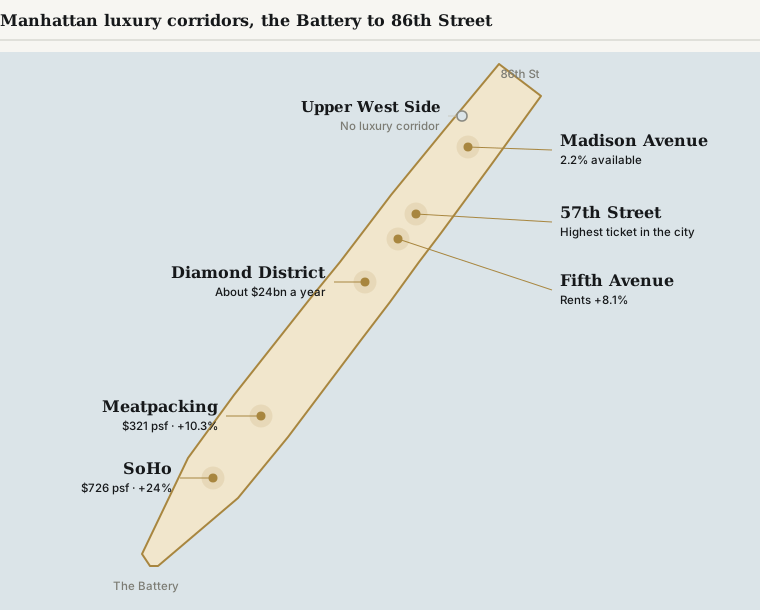
Zooming into that gold cluster: every Manhattan corridor sits between the Battery and 86th Street.
Fifth Avenue, 49th to 59th — the marketing address
The highest absolute revenue in the country, and the lowest conversion rate per visitor.
Fifth Avenue flagships are only partly stores. They are brand advertising with a cash register attached — vast footprints, tourist volume, and a meaningful share of traffic that will never buy anything. Tiffany's Landmark runs close to 110,000 square feet. That space is not underwritten on transactions alone.
The market agrees on the direction: rents rose 8.1 per cent year-on-year and availability tightened to 11.6 per cent by Q2 2026. Globally, Fifth now ranks third most expensive retail street in the world — displaced not by weakness but by London's New Bond Street rising to $2,231 per square foot per year.
What it demands of you: volume, languages, stamina, composure under constant footfall. You will serve more people in a week than a Madison advisor serves in a quarter, and convert a far smaller share of them. Superb training ground. Slow book-building.
Madison Avenue, 60th to 86th — the selling address
The most concentrated luxury hiring market in the United States, and the hardest to get into. Availability sits at 2.2 per cent. Actively marketed storefronts fell from 35 to 13 in two years. Fewer than twenty spaces are on the market across the entire corridor.
Madison runs on clienteling: private appointments, salon-style selling, repeat clients, VIC relationships measured in years. Lower traffic, dramatically higher close rate, far higher lifetime value per client. The corridor has been concentrating in menswear and jewellery — the two most margin-dense, appointment-driven categories in the business.
What it demands of you: a book, discretion, and patience. Madison hires on relationships more than on presence. Advisors here are not measured on daily transactions; they are measured on who calls them back next season.
57th Street, Fifth to Park — the highest ticket in the city
The watch and high-jewellery spine. Moderate traffic, extreme average transaction value. A quiet afternoon here can outsell a busy Saturday almost anywhere else.
What it demands of you: genuine product expertise. This is the one corridor where technical knowledge — movements, provenance, stones, servicing — outweighs selling technique. Careers here are built on credibility, not charm.
47th Street, the Diamond District — the invisible giant
The largest luxury-goods trading volume in New York, and it appears in no retail report anywhere.
- More than 2,600 businesses
- 33,000 people employed
- Roughly $400 million in transactions daily
- Approaching $24 billion a year
- An estimated 90 per cent of all diamonds entering the United States pass through this one block
No corridor in the city moves anything close to that value. It is invisible in retail statistics because almost none of it is retail — it is trade, wholesale, cutting, grading, negotiated and often cash.
What it demands of you: it is a different industry with a different door. Entry is relationship-based, frequently family-based, and largely closed to conventional retail CVs. But for anyone serious about stones, it is where the actual expertise in this country lives.
SoHo — two markets in twenty blocks
The most misread district in New York. Call SoHo mid-tier and you have described one street and missed the other. It is the largest urban retail district in the United States, and it is bifurcated. Broadway, from Houston to Broome, carries Zara, Uniqlo and heavy tourist footfall. The cast-iron side streets — Greene, Wooster, Mercer, Prince, Spring — carry full-price flagships and concept stores.
Broadway drags the average ticket down and hides what is happening one block west. Jacquemus chose Spring Street for its first US store. Dior opened a standalone fragrance and beauty boutique at Prince and Greene. Balenciaga took nearly 10,000 square feet on Greene Street. A house does not test a new category in a district it considers mid-market — it tests where it believes its future client already shops.
The numbers follow. Broadway asking rents hit $726 per square foot, up 24 per cent in six months, now only 12 per cent below the 2016 all-time peak — the strongest recovery ratio in Manhattan. Availability is at its lowest since 2012, with fewer than twenty spaces marketed: the same scarcity as Madison, produced by entirely different economics.
The right description is not "up and coming." The buildings, the tenancy and the tourist flow have been in place for twenty-five years. What changed is who the luxury client is — and that client shops SoHo before Madison.
The selling motion is different, and this is the part that matters for your career. Madison closes through appointments and an existing book. SoHo closes through footfall, storytelling and first-purchase conversion. Same houses, same price points at the top end, completely different job. The ticket spread here runs from $200 to $50,000 in the same afternoon — high end without high ceremony: open-floor, walk-in, editorial, not salon.
What it demands of you: cultural fluency, pace, and the ability to convert a stranger. SoHo advisors create clients. Madison advisors keep them. Both are hard. Neither transfers automatically.
Meatpacking and Third Avenue
Meatpacking: rents up 10.3 per cent year-on-year to $321 per square foot, roughly twenty new tenants in 2025, occupancy at a historic high. Tourism-heavy and experiential, not yet a close-heavy district — and growing corridors hire more freely than mature ones.
Third Avenue: up 10.6 per cent to $281 per square foot. Not a luxury corridor, but it captures the Upper East Side resident who is not shopping Madison that day. Premium, not luxury, and hiring accordingly.
Where the ground is moving the other way
- Lower Manhattan and the Financial District: down 13.2 per cent year-on-year
- Flatiron and Union Square: down 10.5 per cent
- Times Square: down 10.0 per cent
- Herald Square: $383 per square foot, down from $447
Times Square, Herald Square, the Financial District and Upper Fifth together hold roughly 60 per cent of every available storefront in Manhattan. Foot traffic and commercial value are not the same thing, and Times Square is the permanent proof.
For recruiters, these corridors are a candidate pool, not a hiring market. Experienced staff are being displaced from them right now.
Beyond Manhattan: the rest of the map, ranked
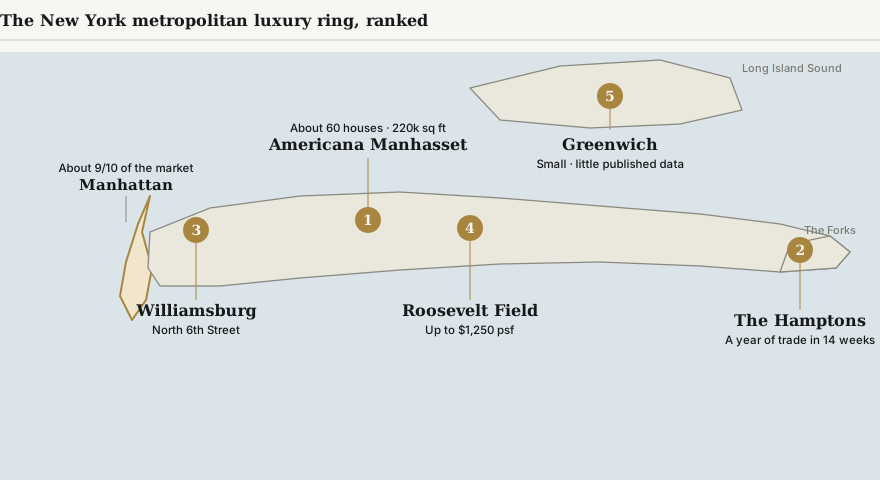
Manhattan is not the whole market. It is roughly nine-tenths of it. Here is everything else, ranked by how much it should matter to your career.
1. Americana Manhasset — the only true Madison substitute
Long Island, twenty-five minutes from Midtown. Roughly 220,000 square feet, around 60 brands, and the roster is not a compromise: Hermès, Chanel, Louis Vuitton, Cartier, Van Cleef & Arpels, Dior, Prada, Gucci, Bottega Veneta, Céline, Tiffany, Saint Laurent, Zegna, Kiton.
It runs the Madison model — personal shoppers, concierge, appointment-led, deep repeat clientele — for North Shore wealth that does not want to drive into the city. Privately held by Castagna Realty, which is why it never appears in the corridor reports.
Why it matters to you: it recruits directly from Manhattan and pays competitively, because it has to. For an advisor with a book, it can mean the same clients, the same brands and a fraction of the commute. It is the single most underrated luxury career move in the New York region.
2. The Hamptons — the highest-intensity season in America
East Hampton on Newtown Lane and Main Street, Southampton on Jobs Lane and Main Street. Chanel operates a full permanent boutique at 17 Newtown Lane. Creed, Stuart Weitzman, Kith and a rotating cast of houses run seasonal boutiques and pop-ups from Memorial Day to Labor Day, some through October.
The economics are unique: a large share of annual revenue is compressed into roughly fourteen weeks, against clientele with among the highest net worth density in the world.
Why it matters to you: seasonal luxury retail is a real career track, not a summer job. Season leads, pop-up managers and client advisors who can run a high-value floor for a compressed, high-stakes window are a distinct and well-paid specialism. It is also the fastest way to meet clients who shop Madison the other nine months.
3. Williamsburg — the only outer borough with flagship capital
North 6th Street is Brooklyn's flagship street; Zara and Bylt recently took 24,000 square feet between them. Bedford Avenue, Park Slope's Seventh Avenue and DUMBO lead Brooklyn on rent growth.
But roughly 80 per cent of Brooklyn's retail inventory is under 2,500 square feet. Luxury flagships need five to fifteen thousand. The space does not physically exist. Watch North 6th; do not plan a luxury career around the borough yet.
4. Roosevelt Field, Short Hills, American Dream, Ridge Hill
Regional centres capturing suburban and outer-borough spend. Roosevelt Field runs sales of up to $1,250 per square foot at more than 96 per cent occupancy — strong retail productivity, but premium and contemporary rather than hard luxury.
Why it matters to you: excellent volume training and genuine management ladders. Not where private-client careers are built.
5. Greenwich Avenue, Connecticut
Serious wealth, a handful of luxury doors, very little published market data. Real but small. Worth knowing; not worth relocating for without a specific offer.
6. Queens, the Bronx, Staten Island — no luxury corridor
Fordham Road carries some of the heaviest foot traffic in New York and no luxury at all. Jackson Heights' 74th Street moves serious volume in gold and bridal, but entirely outside the Western houses. Empire Outlets is off-price.
This is not a data gap. It is the finding.
7. The Upper West Side — none
Not thin. None. Neighbourhood service, food, fitness and medical. Any comparison of East Side versus West Side luxury retail is a comparison with one side missing.
The Bronx and Queens have the footfall. Manhasset and East Hampton have the money. Luxury retail follows the second one every time — and so should your job search.
The distinction that should shape your next move
Fifth Avenue is a marketing address. Madison is a selling address.
Fifth gives you scale, brand names, international traffic and a fast education. Madison gives you a book, a client list and compounding income. SoHo gives you the next generation of client — the one Madison will be trying to reach in ten years. 57th Street gives you expertise that travels anywhere in the world.
Madison is defending a peak. SoHo is capturing a client. If you are early in your career, that difference is worth more than the title on the offer letter.
Highest store revenue and highest personal earning potential are not the same corridor — and most people discover this three years too late.
There is also an entire tier of luxury work that appears in no retail statistic at all: private client, art advisory, watch servicing, bespoke, high-jewellery consignment. It sits almost entirely on Madison and 57th Street. If that is the career you want, the corridor decision is already made for you.
What we are seeing in the market
With Madison at 2.2 per cent availability and SoHo at a fourteen-year low, headcount in the strongest corridors grows by replacement and depth — not by new doors. Roles open rarely and close fast. Meanwhile the declining corridors are releasing experienced people into the market every quarter.
That combination — scarce openings at the top, rising supply at the bottom — is the single most important thing happening in New York luxury retail hiring right now.
Luxury Recruiter places client advisors, boutique managers and private client specialists across watches, jewellery and fashion. Browse current roles, or read the US luxury retail salary guide.
Hiring for a New York boutique? Talk to us about your search
Sources
- Cushman & Wakefield — Manhattan Retail MarketBeat, Q2 2026
- Cushman & Wakefield — Main Streets Across the World 2025
- Cushman & Wakefield — The Evolving Luxury Retail Landscape in New York and Los Angeles
- REBNY — Manhattan Retail Report, First Half 2026
- REBNY — H2 2025 Manhattan Retail Report
- REBNY — Brooklyn Retail Report
- 47th Street Diamond District — History and figures
- Commercial Observer — SoHo retail rents hit decade-long high
- Commercial Observer — L3 Capital secures 24K SF for Bylt Basics and Zara flagships in Williamsburg
- WWD — Jacquemus opens first U.S. store on Spring Street
- CoStar — Kering buys Fifth Avenue retail property for $963 million
- CRE Daily — Retail productivity rises as luxury malls outpace sector