Every conversation about pay in luxury retail starts in the wrong place. It starts with the number at the bottom — what an associate earns, whether it is livable, how it compares to the price of the object in the vitrine. That conversation is worth having, and we have had it. But it obscures a structural change that is harder to see and considerably more damaging: the distance between the bottom of the ladder and the top of it is closing.
A floor set by statute
The bottom has been rising on a schedule, and the schedule is law. New York City's minimum wage went to $16.00 in January 2024, $16.50 in January 2025, and $17.00 in January 2026 — a third consecutive increase under the 2023 agreement between the Governor and the Legislature. From 2027 it indexes annually to the Consumer Price Index for Urban Wage Earners in the Northeast. No employer negotiates this. It arrives every January, and it is absorbed.
That is a good policy and a real gain for the people it reaches. It is also, for any operator running a store in this city, a fixed and rising cost that must be found somewhere in the payroll line.
A ceiling nobody legislated
Above that floor, the picture inverts. Salary.com's tracking of luxury store manager compensation shows the median falling from $80,613 in 2023 to roughly $80,419 in 2025 — a nominal decline, before any adjustment for inflation. Its luxury retail manager series moves the same direction, from $66,865 in 2024 to $66,026 in 2025. On the floor itself, ZipRecruiter's August 2026 reading puts average luxury retail base pay at $32,808 a year, or $15.77 an hour, essentially unchanged across successive 2026 snapshots.
Set those base figures against what the city actually costs and the arithmetic becomes difficult to look at directly.
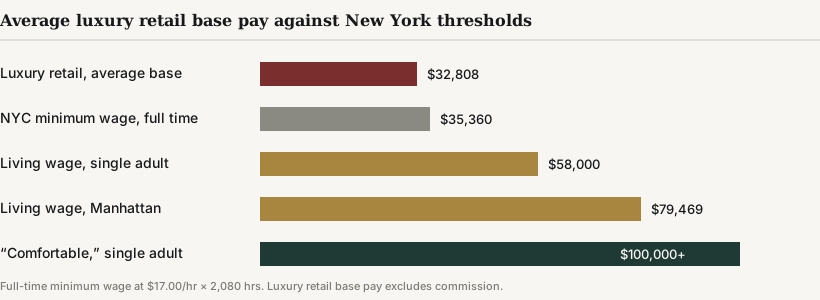
The average base salary in luxury retail nationally now sits below what a full-time minimum wage job pays in New York City. Commission closes part of that gap for strong sellers in strong doors, and nobody should pretend otherwise. But commission is variable, it is concentrated among a minority of the floor, and it is not what a house is committing to when it makes an offer.
The multiple that keeps shrinking
The clearest way to see the compression is not in either number alone but in the ratio between them — what a manager earns as a multiple of the legal floor beneath her.
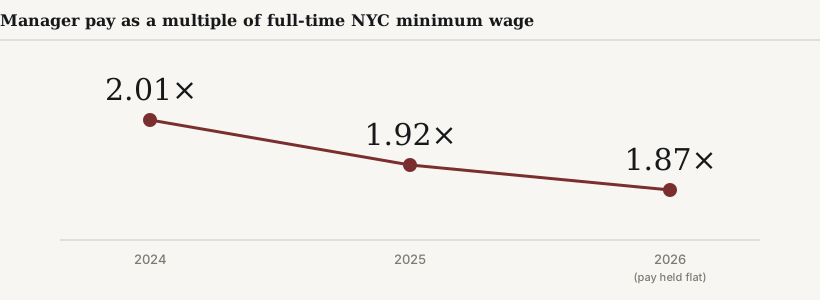
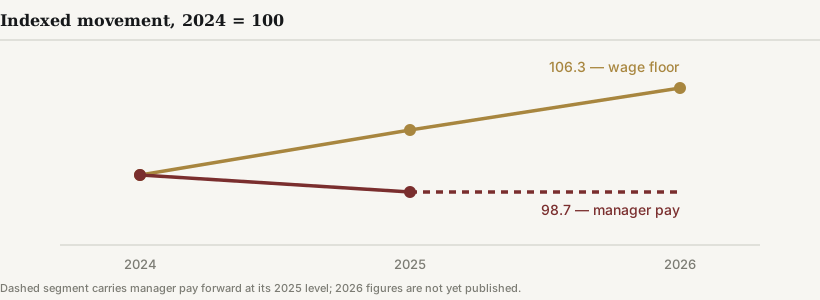
In 2024 a luxury retail manager earned almost exactly twice the full-time minimum wage. A year later it was 1.92 times. Hold that salary flat through the January 2026 increase — which is what the tracking data suggests is happening — and it is 1.87 times. The floor is climbing toward the ceiling because the ceiling is standing still.
Why luxury cannot shrug this off
Mass retail has always run a narrow band, and it runs one deliberately. Where turnover is expected, training is short and the skill differential between a first-week hire and a fifth-year associate is genuinely small, there is little commercial reason to pay for tenure. The band stays tight because the work does not require it to widen.
Luxury retail sells the opposite premise. Its entire case — to clients, to candidates, to itself — is that the person across the counter is not interchangeable: that product depth, discretion, and a client book built over years are what justify both the price of the object and the margin on it. That premise requires a wide band. It requires the gap between the floor and the ceiling to be visible enough that a talented advisor can look up and see a decade of reasons to stay.
A compressed band does not merely underpay senior people. It quietly retracts the argument for becoming one.
The stillness that looks like stability
Here is the part that rarely gets named, because on a report it looks like good news. Compression does not usually produce resignations at the senior level. It produces the opposite: stillness.
When the ceiling is flat at your house, it is generally flat at the house across the street too. Moving means surrendering a client book, restarting inside an unfamiliar culture, and rebuilding standing with a new regional director — all for a lateral number. So the tenured layer stops moving. Store managers, senior advisors and boutique directors settle in, protect what they have, and quietly stop expecting the role to grow underneath them.
Read as a metric, that reads like retention. Read honestly, it is something closer to the reverse: people securing an income rather than building a career, present on the floor but no longer moving through the organisation. Low senior turnover in a compressed market is not proof that a house is holding its talent. It is often proof that the market has stopped offering anywhere better to go — and the moment any competitor does move its ceiling, that stillness ends abruptly and all at once.
What we would tell a house
Three things, none of them expensive relative to what they protect. Price the ceiling deliberately rather than by default, because minimum-wage compliance is legislated and senior pay is not, which means the second one gets frozen quietly while the first one gets paid. Publish the band, now that pay transparency law is doing it for you in most of your markets anyway — a visible ladder is a retention instrument, and an invisible one is a resignation waiting for its moment. And measure the multiple, not the salary: if the distance between your entry rate and your store manager's is narrowing year over year, you have a structural problem that no individual raise will fix. Our H1 2026 US salary guide maps where those bands currently sit.
We have placed executives who have rebuilt compensation architecture inside houses facing exactly this, and the work is less about headline numbers than about restoring a slope people can see. That is a longer conversation than an article, and it is one we are glad to have. But the diagnostic is short, and any operator can run it this week: divide your store manager's salary by your entry-level annualised rate, then do the same for two years ago. If the number went down, the ladder got shorter — and the people standing on it have already noticed. Rethinking what your ladder actually pays?
From the floor to the boutique director — build a ladder people can see. Talk to us about your team
Sources
- Office of Governor Kathy Hochul — Minimum wage increase to $17.00 on January 1, 2026
- Proskauer, Law and the Workplace — New York State Minimum Wage and Exempt Salary Updates for 2026
- Salary.com — Luxury Store Manager salary research
- Salary.com — Luxury Retail Manager salary research
- ZipRecruiter — Luxury Retail salary data, August 2026
- Indeed Hiring Lab — Q2 2026 Employment Cost Index: Losing Ground